The 7 Best E-Readers To Buy: Comparing Kindles, Kobos, IPads, And More
You won’t miss the feeling of paper with these e-readers.
By
Samantha Mangino
Samantha Mangino
Shopping Reporter
Boston-based Shopping Reporter, Samantha Mangino, covers all things tech at Mashable, rounding up the best products and deals. She’s covered commerce for three years, spending extensive time testing and reviewing all things home, including couches, steam irons, and washing machines. She thoroughly vets products and internet trends, finding out if those cozy gamer chairs are really as comfortable as TikTok claims.
Read Full Bio
on February 21, 2026
All products featured here are independently selected by our editors and writers. If you buy something through links on our site, Mashable may earn an affiliate commission.
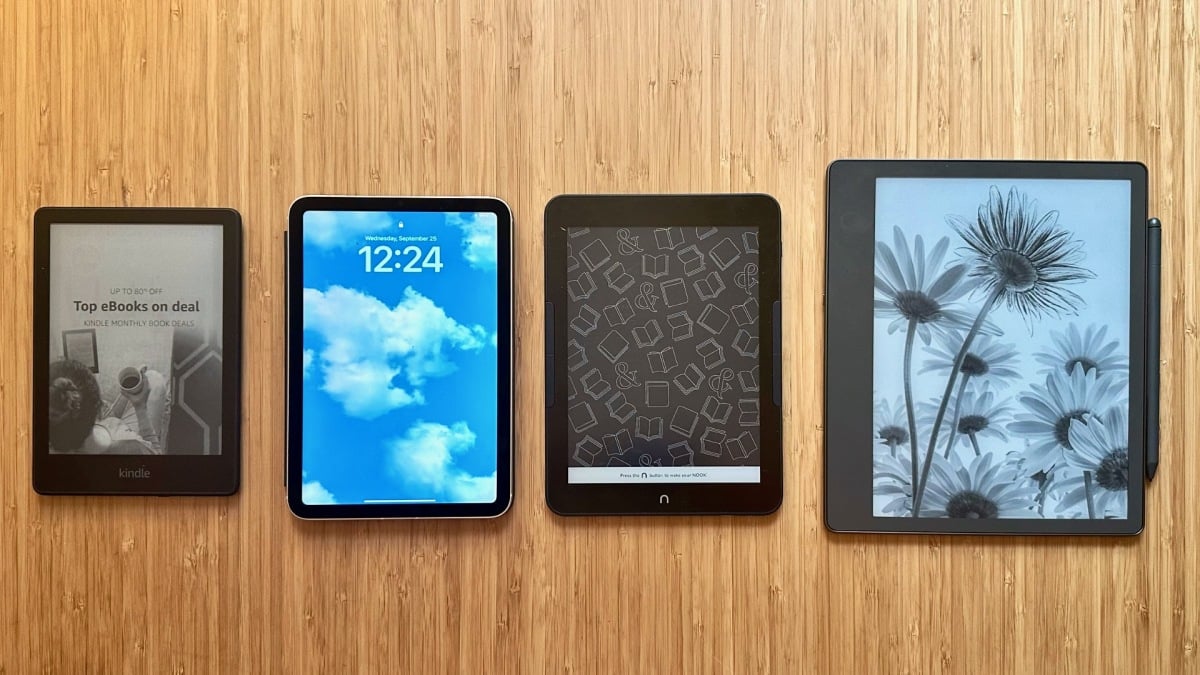
Credit: Samantha Mangino / Mashable
While you can’t replace the feel of paper — the beauty of bound hardcovers and the ritual of turning the page — an e-reader brings convenience and portability that a physical book just can’t beat. Sure, you can throw a book in your tote bag, but what about an entire library?
When you think of the best e-readers, your first thought is likely an Amazon Kindle; however, this isn’t a list of the best Kindles, although we do have a list of those, too. While Kindles are great — there’s certainly no denying that — you can find a couple of equally wonderful alternatives.
Table of Contents So, what is the best e-reader for 2026? I’m regularly testing new e-readers (and tablets) and cycling through different models to stay up to date on the best options available. So, if you’re gearing up to read more books this year, I can recommend a model you’ll love.
Our Pick
Good storage option Warm light adjusts from white to amber 20% faster page turns 12-week battery life Fully waterproof Ad-free version more expensive Brightness doesn’t auto-adjust Read our full review of the Kindle Paperwhite.
After several months of testing the Kindle Paperwhite against other e-readers, I always came back to the Kindle Paperwhite as my preferred e-reader. While the Kobo Clara Colour impressed me initially, the Kindle Paperwhite proved to be a faster device with better battery life.
If Amazon is pretty intrinsic to your spending, then going for a Kindle, specifically the Paperwhite, makes the most sense. Amazon promised that the 2024 Kindle Paperwhite would be the fastest yet, and it delivered. It turns pages without stuttering, never slowing down when you’re in the thick of the action.
The screen is vibrant and has adjustable brightness, meaning it can adjust when transitioning from reading in bright sunlight to dimmer indoors. It also comes with adjustable screen warmth, perfect for evening readers who want to give their eyes a chance to relax. It’s lightweight and fits comfortably in small crossbody bags. Plus, it’s waterproof, keeping it safe against poolside vacations and spilled water bottles in bags.
It’s generally the best e-reader, but it’s also the best e-reader for Libby. If you use Libby to its fullest potential, with your account loaded with multiple library cards, the Kindle allows you to read from all of those accounts at once, something you can’t do on a Kobo e-reader.
Not a ton has changed between the 2022 (our previous pick) and 2024 models of the Kindle Paperwhite, but I can say for certain that the 2024 Kindle Paperwhite is the sleekest, fastest e-reader yet. It now has a slightly bigger screen at 7 inches compared to the previous 6.8-inch model, but the change is minuscule — besides the fact that the bigger model is slightly too big for my old Kindle case.
The 2024 Paperwhite has gotten a slight upgrade in screen quality compared to the 2022 Paperwhite. While the resolution is still 300 ppi, it appears to have higher contrast, straying away from the like-paper look and edging closer to the look of a tablet. Don’t worry, though — unlike tablets, the Kindle Paperwhite still has a gloriously glare-free screen. It still has an IPX68 waterproof rating, so you can get some leisurely reading in the bath.
In his review of the 2022 model, Mashable senior editor Stan Schroeder found only one extremely minor quibble with the Paperwhite Signature Edition, and I have to agree with him. On all Kindle models (besides the Scribe), the power button sits on the bottom, resulting in many accidental presses. This was the case with the prior Paperwhite model, and I was hoping that it’d move up top for the new model, but alas, Amazon has not made all the improvements it could have. Additionally, I wish this Kindle Paperwhite had page-turning buttons like the now-discontinued Kindle Oasis or the Kobo Libra Colour for a more ergonomic design.
A big reason why I came back to the Kindle Paperwhite as the best overall e-reader is its processor. It’s exceptionally fast and updates quickly. With Kobo e-readers, I had to manually sync them to get my library books to appear. The only feature I wish the operating system of the Paperwhite had was the ability to recalculate the page count of a book when you adjust the font size or margins.
That said, the Kindle Paperwhite is still the best e-reader you can buy.
Matte, glare-free display Perfect screen size Adjusts page count based on font Color display Waterproof Ad-free No page-turning buttons Can’t log in to multiple library accounts at once No Amazon integration (though that may be a pro) Watch our comparison of the Kobo Clara Colour and Kindle Paperwhite.
If you’re just diving into the world of e-readers and not particularly thrilled about Kindles and their Amazon ties, then the Kobo Clara is the right answer. It offers a color display for those who enjoy manga and graphic novels, but it remains speedy with fast processing when turning pages or swapping between books.
It’s especially great for Libby users, who want seamless integration with books that automatically load into your library as soon as you borrow them. It really is a great e-reader for anyone.
Having tried my hand at nearly a dozen e-readers in all shapes, sizes, and brands, I wasn’t expecting to be so deeply impressed by the Kobo Clara Colour, but it is a wonderful e-reader. With a 6-inch screen, it’s slightly smaller than the Kindle Paperwhite, but it allows you to hold it comfortably for multiple hours at a time without any wrist or arm fatigue.
In my previous testing with Kobo devices, I’ve really liked them, but one sticking point is that they’re slower than Kindles. Initially, I found that the Kobo Clara kept up with the Paperwhite, but after several months of use, it had a tendency to lag. Compared to Kindles, I had to manually sync the Kobo Clara to get my library books to show up.
Its processing system is otherwise really smart and fixes one of my biggest e-reader pet peeves. When you adjust the font size on a Kindle, the device doesn’t recalculate how many pages are in the book, making it inaccurate, so you don’t know exactly how many pages you have left in a chapter. The Kobo Clara does recalculate page count accurately for a more exact reading experience. Though, one thing to note: Kobo counts the number of digital pages, whereas Kindle page numbers typically match up with physical book copies.
For the same price as the Kindle Paperwhite, the Kobo Clara offers color displays, something you can’t get in the Kindle lineup unless you’re willing to spend $250. The colors aren’t as bright as you’d experience in a physical book, but they’re still vivid enough to enjoy a graphic novel.
Its Libby (aka Overdrive) integration is seamless, and e-books you borrow on your library card will automatically populate on your account. You can browse and borrow library books directly from the e-reader, instead of having to whip out your phone app. However, for users who use Libby to the max with multiple library cards, you can only log in to one account at a time.
The Kobo Clara’s biggest downfall is its battery life. It’s supposed to last up to 42 days, although many online users say it averages out at about two weeks. That’s quite pathetic in the face of the Kindle’s 12-week battery life; however, I’d trade in a better reading experience over a couple weeks of battery life any day.
Compact size Most lightweight Kindle Best of the basics Generous storage space Cover sold separately Not waterproof No warm light Short battery life compared to other Kindle models Read our full review of the Kindle (2024).
If you want to dip your toes into e-readers, the standard Kindle model is the best budget-friendly model. Like the Paperwhite, it has 16GB of storage, with room for thousands of books. It’s the smallest Kindle, and you won’t miss the size of the Paperwhite. Instead, you’ll be delighted that it’s genuinely pocket-sized. Plus, if you want an e-reader with some flair, it’s now available in black and matcha, a vibrant light green.
After testing the Kindle Paperwhite and Kobo Libra Colour, I thought I’d be ruined for the basic Kindle, but I found it to be an equally great device. It comes in a smaller package, the lightest e-reader here. Plus, the six-inch size makes it practically pocket-sized. Generally, it feels nicer to hold in my hand and bring on the go with me — exactly what I want in an e-reader.
Sure, it’s not as high-tech as the Paperwhite, but I think it’s an even better size. The screen has the exact resolution as the Paperwhite, but just a bit smaller. You lose some screen space with its plastic casing, but I didn’t mind. I liked the rimmed front design, making it easier to hold while using. It also has the bottom power button, which is far less touchy than the other Kindle models, and it was harder to turn the device on or off accidentally.
Functionally, it’s comparable to the Paperwhite. The biggest feature the standard Kindle lacks is adjustable warmth, which I worked around by using Dark Mode at night. However, the standard Kindle would be perfect if it were waterproof. That’s the biggest downside to me, as someone who needs to be able to take it to the beach.
That being said, it is the most affordable, and it’s a worthy sacrifice not to have waterproofing for its $109.99 price.
The perfect size for being portable without being too small Buttons are excellent for turning the pages Generally well-designed Color (especially highlights) show up clearly OverDrive integration is seamless and beats Kindle’s options Pocket integration is great for folks who love to read articles Palm rejection could use some work Kobo’s online store isn’t as expansive (or affordable) as Amazon’s Some ghosting issues occasionally Notebook mode could use some work Battery life could be better Read our full review of the Kobo Libra Colour.
For serious readers who don’t mind splurging a little, the Kobo Libra Colour delivers an upgraded e-reader experience. With a similar seven-inch display, the Libra Colour offers two features the Kindle Paperwhite cannot: Color and note-taking. Book covers, in-book illustrations, and photos are all featured in color with the Libra. And if you’re an annotator, you can highlight and mark up your pages in different colors to stay organized. In the Kindle family, only the Scribe supports scribbling, and with a higher price tag.
It’s equipped with more than enough storage at 32GB and is waterproof. Plus, if you were devastated by the discontinuation of the Kindle Oasis, the Libra Colour offers a similar design that includes page-turning buttons.
If you were to ask me which e-reader to buy, it’s a real toss-up between the Kindle Paperwhite and the Kobo Libra Colour. While the Kobo Libra Colour is expensive at $229.99, it’s worth its price tag, something I can’t say is true for Amazon’s Paperwhite Signature Edition.
Above all, the Kobo Libra Colour has the best ergonomic design. It’s more square than a Kindle, as one side offers extra space for page-turning buttons. This makes it easier to hold, especially while lying down and reading one-handed. It’s the only e-reader (besides the iPad) on this list that has an internal gyroscope, so when you rotate the device, the display rotates with it. While reading in bed, if I flipped over, I could rotate the device to still be able to hold it on the side with page-turning buttons.
The Overdrive (aka Libby) integration is great as you can log in with your library card, and your borrowed e-books instantly populate on the Overdrive tab. While this is a more seamless integration than Kindle, I do have some minor beef with it. On a Kobo, you can only log in to one library card at a time, so if you borrow using multiple cards, you might be signing in and out of different accounts often. Plus, while using the Kobo Libra Colour, one of the library books I borrowed wasn’t available on the Kobo and I had to switch to the Paperwhite to be able to access it.
While the color display on the Kobo is nice, it is still rather muted. While reading Heartstopper, the colors were quite toned down in comparison to how they appeared on the iPad Mini. The Libra Colour’s battery life isn’t as strong as a Kindle Paperwhite’s. While testing the Kobo Libra Colour over 10 weeks, my colleague Bethany Allard had to charge the device twice. Plus, it’s a bit slower than a Kindle with the occasional stall while switching between books.
While the Kindle may have the Kobo beat on processing and battery life, I still think the Libra Colour is a worthy upgrade as it offers the best design of an e-reader with the perk of color. Amazon’s first color e-reader, the Colorsoft, costs $279.99, so at $229.99, the Libra is a bargain.
Great battery life Zoom feature works well Ad-free homescreen No auto-adjusting brightness Some color flashing Expensive Read our full review of the Kindle Colorsoft.
The Kindle Colorsoft brings color to the digital page, making it great for graphic novel readers, those who like to annotate in color, or fans of experiencing the cover page in full color. Its included zoom feature allows you to focus and get an up close look at illustrations, especially handy when reading comics. While we think that the Kobo Libra Colour is a better e-reader, the Kindle Colorsoft is the best color Kindle if you’d prefer to be in the Kindle ecosystem.
E-reader users have long had to accept reading exclusively in black and white on Kindles, but the Colorsoft changes things. The Colorsoft uses an E Ink Kaleido 3 display to support its color display. In black and white, it has its standard 300 ppi resolution, but in color, it maxes out at 150 ppi.
Amazon currently has three color Kindles: the Colorsoft, Colorsoft Signature Edition, Kindle Scribe Colorsoft, and Colorsoft Kids. Our preferred model is the standard Colorsoft, which was just released in July 2025. It comes with 16GB of storage and a slightly more affordable price tag of $249.99, better when compared to the Signature Edition’s $279.99.
The color on the Kindle Colorsoft is accurate to what you’d find in a printed copy; however, it is slightly muted. When reading in black and white, it’s as fast as any other Kindle we’ve tested, but the color displays slow things down a bit. When reading in color, the pages sometimes flash as they load, a problem that most color e-readers currently suffer.
While the Kindle Colorsoft works well, I wouldn’t say it’s able to totally justify its $249.99 price. Compared to the other model that Amazon offers, it’s certainly a better value. But if you’re looking for a color e-reader, I recommend avoiding Kindle entirely and going for either the Kobo Clara or Libra Colour.
But if you’re really committed to the Kindle ecosystem, the Colorsoft is your best choice for reading in color.
Waterproof Adjustable warm light Worry-free guarantee 6 months of Kindle Kids+ Choice of cover included Black-and-white interface More expensive than regular Paperwhite If you’re raising a voracious reader, the Kindle Paperwhite Kids is the best e-reader for kids. It’s waterproof, which means it stands up to juice spills and dips in the pool. Plus, it comes with a built-in case. It’s designed to be kid-proof, not just physically, but also with built-in parental controls. If you’re concerned about monitoring your kid’s bookshelf, this Kindle allows you to approve downloads by kids and displays age-friendly titles that kids can easily access.
One area where Amazon has all other e-reader brands beat is in the kids market. There are special kid-friendly models of the basic Kindle, Kindle Paperwhite, and Kindle Colorsoft. Our preferred model for kids is the Kindle Paperwhite Kids.
More than anything else, an e-reader for kids has to be waterproof, which is why the Kindle Paperwhite Kids is the best choice. It comes with everything we like about the standard Paperwhite: a beautiful, high-resolution screen that works faster than any previous generation.
But what makes it great for kids is that it’s a distraction-free device. It doesn’t come with ads, notifications, or the temptation of games or video. I also like that it’s a bit heavier than the standard Paperwhite, giving it a sturdier design. Plus, the built-in case adds an extra level of protection.
The parental controls are easy to use and set up, and the device also comes with a six-month free subscription to Amazon Kids+, which provides unlimited access to thousands of age-appropriate books. The library of books is easy for kids to navigate and offers classics like Lois Lowry’s The Giver and modern classics like Diary of a Wimpy Kid.
What I don’t love is the price. At $179.99, it’s more expensive than the standard Paperwhite. If you want to go for a budget kids’ pick, I’d recommend the standard Kindle, which you can set up as a kids’ device during setup to ensure parental controls and add an Amazon Kids+ subscription for $5.99 per month. Plus, as your kid ages, you won’t have to upgrade to a more teen-friendly e-reader.
Better proportions than previous models New front light creates a brighter surface Well-organized home screen Fantastic note organization Expensive Hard to hold for long periods of time Read our full review of the Kindle Scribe (3rd Generation).
If, looking through your bookshelf, your books have dog-eared pages, highlighted lines, and scribbles in the margins, your instinct might be that an e-reader isn’t for you, but I’d like to introduce you to the Kindle Scribe. It’s the only Kindle with writing capabilities and comes with an included stylus pen that magnetically attaches to the side of the e-reader; it’s ready for all your handwritten thoughts.
The pen moves nicely across the screen, mimicking the texture of writing on paper. In addition to a library of books, the Kindle Scribe also comes with a journal section where you can take notes. The notes feature is especially great for students who want to handwrite notes and convert their handwriting into text.
The 2025 Kindle Scribe got a much-needed upgrade. All the good stuff has held over with the addition of some major improvements.
It’s still big, with an 11-inch display, which does make it a little more awkward to hold while reading, but for writing or annotating, it’s optimal. Unlike other tablets (I’m looking at you, iPads) that require you to buy a pen separately, the Kindle Scribe comes with a pen that conveniently attaches to the side so it doesn’t get lost. However, it’s not the most secure magnetic hold, so be careful not to bump the pen off accidentally.
Writing on the Kindle Scribe is a joy. Before testing this e-reader, I used my iPad and Apple Pencil to annotate readings, but I never loved it because the screen felt too slick for the Apple Pencil. The Kindle Scribe does not suffer this problem, as the matte screen lends some friction to the pen, making it feel like you’re writing on paper. I enjoyed writing with the pen, and I swear my handwriting looked better on the Kindle Scribe than on my iPad.
It finally got a processing update that makes it as speedy as every other Kindle. Gone is the lag when switching between journals and books. Plus, the displays have greatly improved, too, as the 2025 Kindle Scribe has virtually no ghosting. Like the Kindle Paperwhite, the Scribe’s battery life lasts 12 weeks. It also has storage options, with 32GB and 64GB versions available.
It’s not your only option if you want a Kindle that can write. The Scribe Colorsoft is also available, and while we appreciate that model, it’s quite a bit more expensive. The 2025 Scribe is a better value; it just doesn’t have the wow factor of color.
Fast processing Internet capabilities Nice display size Lots of storage Touch ID Short battery life Glare on screen can make it hard to read Read our full review of the Apple iPad mini.
There are so many devices that the modern person is meant to have. If adding an e-reader seems superfluous, I’d recommend a tablet that allows you to read books, stream shows, and browse the internet. The best tablet for reading? It’s the iPad mini.
But why is this iPad better than any other? It’s all about the size. At 8.3 inches, it comfortably sits in your hand and is about the same size as a paperback.
Before testing these e-readers, I read using my 9th-generation iPad, and my main complaint was always the size. After 30 minutes of reading, my hand and wrist would strain holding up all 10.2 inches of the screen. That’s why the 8.3-inch display of the iPad mini was such a treat. Reading with the mini made me feel like I was holding an actual book rather than a laptop screen.
Unsurprisingly, the iPad mini has the most computing power of all the e-readers on this list. It jumps between apps and turns pages without an ounce of hesitation. Plus, it offers the most expansive ways to read books. You can read using Apple’s built-in Apple Books app or download and read within the Kindle and Libby apps. And unlike most e-readers, you can read comics and graphic novels in full color. Plus, it has far more storage than any other e-reader, as the new 7th generation iPad mini now starts at 128GB of storage.
Despite my love of the iPad mini, I have some beef, most of which is with the screen. While I love its overall size, it has a substantial glare problem. I’ve found this to be true with any iPad I’ve read on; the slick glass screen has a glare in almost any environment. That’s no surprise in the sun, but even at night, I found the screen to be a little too shiny, causing my eyes to have some trouble focusing. This does have a fix; if you want your iPad screen to look more like the matte of a Kindle, a screen protector such as Paperlike creates that effect.
Additionally, compared to e-readers, which provide months of battery life, the iPad mini only gets you hours. If you’re reading for a couple of hours a day, you’re probably only charging the iPad once a week, which isn’t a big deal but certainly more than a traditional e-reader.
Other e-readers we’ve tested
From left to right: Kindle Paperwhite, Nook GlowLight 4 Plus, Kindle Scribe Credit: Samantha Mangino / Mashable
The latest e-readers I tested were the Kindle Scribe (2025) and Kindle Scribe Colorsoft. Previously, Kindle Scribes were disappointing e-readers, but Amazon made major improvements on these devices, and now, they’re worthy of your attention. We’ve included the Kindle Scribe (2025) on this list because it’s a better value, even if the Kindle Scribe Colorsoft is technically more impressive. For more details on the Kindle Scribe Colorsoft, you can read our full review.
We’ve also tested the Remarkable PaperPro and Onyx Boox Go 7 as contenders for this list. After several weeks of testing, both devices proved to be pretty good but not quite list-worthy.
Whenever you search for e-readers, Remarkable’s tablets will always pop up in the search results, but unfortunately, it’s hard to obtain ePUB files on the Remarkable. With Remarkable, you can access files within Google Drive, Dropbox, and OneDrive. If you have any locked ePUB files — like from Libby — you won’t be able to access them on a Remarkable tablet. So, after testing the Remarkable tablet myself, it proved to be a better document reader or digital journal than an e-reader.
The Onyx Boox Go 7 is a better e-reader option than the Remarkable. It’s the same size as the Kobo Libra or Amazon Kindle, but it really lags on processing speed. To read ePUB files from Libby required downloading the Adobe Digital Editions app onto the Boox Go 7, and there was so much lag while opening and closing the app. While it was an easier process than getting library books on a Nook, it was still a major pain compared to Kindle or Kobo’s integrations. The Boox Go 7 lagged and took ages to load files. I was most looking forward to testing this Boox because of its page-turning buttons, but unfortunately, I found that they didn’t work on my device.
An e-reader we haven’t gotten around to testing is the Kindle Scribe Colorsoft, which is now available for purchase. We’re trying out some newer names in the e-reader game, including the Xteink X4 and DuRoBo Krono.
What about the Kindle Paperwhite Signature Edition?If you’re familiar with the Kindle lineup, it may come as a surprise that the Kindle Paperwhite Signature Edition isn’t on this list. Don’t get me wrong, it’s great, but I think there are better options. The Signature Edition is an upgraded version of the Paperwhite, and we’ve compared the devices head-to-head. The short version? The Paperwhite is a better value, even with the SE’s added features like auto-adjusting brightness and 32GB of storage.
If you are prepared to spend $200 on an e-reader, though, I say skip the Kindle Paperwhite Signature Edition and go for the Kobo Libra Colour.
Where’s the Nook on this list?In terms of big-name e-readers, you might notice one omission from this list: the Barnes & Noble Nook. I have tested this e-reader, and it was previously featured on this list. However, after testing more devices, it no longer makes the cut. In comparison to any of the Kindles or the Kobo Libra, the Nook has sloth-like performance, making it frustrating to use.
Plus, getting my library books onto the Nook was a nightmare, as it was a multi-step process that required downloading to a computer before uploading to a Nook. Its only redeeming quality was the buttons on either side of the device, which made page turning a breeze. However, unless you are a loyal buyer of Barnes & Noble books, I recommend steering clear of the Nook.
Where to get e-reader books for freeOnce you get an e-reader, it’s time to fill it up with books, and that doesn’t necessarily mean spending money. In fact, you can load up your e-reader without spending a dime; you just need to be a bit resourceful.
The best way to read nearly any book — a classic or hot new release — is with Libby. I have read hundreds of free books with the Libby app — I wouldn’t have been able to test for this guide without it. It connects with your library card, allowing you to borrow from your local library’s digital collection. Plus, both Kobo and Kindle have exceptional Libby integrations.
Another way to build your library is through Stuff Your Kindle Day events. These are 24-hour opportunities led by authors that make books discounted or free.
If you’re a fan of the classics or looking to discover a treasure lost to time, an online resource like Project Gutenberg has more than 75,000 books in the public domain that you can download and read on an e-reader.
Frequently Asked Questions The best Kindle is the Kindle Paperwhite. Overall, it strikes the right balance of performance and value, while possessing everything we want in an e-reader. The standard Kindle is great for those on a budget, but it’s not waterproof, and while the Kindle Paperwhite Signature Edition is certainly the most advanced Kindle, the extra features aren’t worth its nearly $200 price tag.
Our two favorite e-readers come from Kindle and Kobo, but is one better than the other? It depends on what you’re looking for. If performance is your primary concern, then a Kindle, specifically the Paperwhite, is better as it outperforms the Kobo Libra Colour in terms of speed when turning pages or loading books. However the Kobo Clara Colour measures up to the Paperwhite’s performance.
If you’re looking to de-Amazon your life, then a Kobo e-reader is the better e-reader. It offers all the things we like in a Kindle, such as Libby integration, adjustable brightness and warmth, a waterproof rating, and an overall better-designed package. While Amazon discontinued its Kindle Oasis, an e-reader with page-turning buttons, the Kobo Libra Colour has not abandoned this fan-favorite design. It also features an internal gyroscope so you can rotate the Kobo for a better ergonomic experience.
Yes, you can read on an iPad, and as an iPad reader, I highly recommend it. iPads come with the Apple Books app. However, other reading apps, including Libby and the Kindle app, give access to the world of books.
For this reason, I included an iPad in my testing. The iPad Mini made my list because it is the perfect size to feel like you’re reading a paperback novel versus larger iPad models like the 9th generation, which feel like reading a clunky magazine.
Buying an e-reader is a far more significant investment than going to the bookstore. Plus, you still have to buy e-books. At first glance, it seems like an expensive adventure. Luckily, even with an e-reader, you can support your local library. With Libby, you can borrow and read audio and e-books from your local library and get them on your digital e-reader.
Libby has an iOS app and can instantly send books to your Kindle. If you don’t happen to have a Kindle or iPad, you can still upload your library books through Adobe Digital Edition. Aka, you can still support your local library — and not pay a single penny to read a new book.
I tested each of these e-readers over several weeks, reading at least one book per device in different environments. Here are the criteria upon which we decided this guide.
How easy was it to download and read new books from Libby or the Amazon store? Did the Scribe’s stylus work smoothly? Is the user interface intuitive or was there a learning curve? I also noted which e-readers work best with Libby, for easy access to library books.
E-reader models vary wildly in price; I made sure to include affordable options as well as splurge-worthy models that are a good value.
This includes auto-adjusting displays for indoor/outdoor reading, warm light settings to block blue light, note-taking abilities, and page turn buttons for one-handed reading.
I made sure to pinpoint which models are waterproof for a worry-free outdoor reading experience as well as those better suited for children.
Boston-based Shopping Reporter, Samantha Mangino, covers all things tech at Mashable, rounding up the best products and deals. She’s covered commerce for three years, spending extensive time testing and reviewing all things home, including couches, steam irons, and washing machines. She thoroughly vets products and internet trends, finding out if those cozy gamer chairs are really as comfortable as TikTok claims.